

Explore Listing
 General Sir Hubert Gough, who had commanded the Fifth Army during the First World War, drew the British public's attention to the contribution made by Ireland's citizens in the current British war effort with his letter to The Times of London on 26 September 1941. He wrote that '... very large numbers of Irishmen have joined H.M. Forces since the outbreak of war'. He went on to emphasise the excellent military qualities of Irish troops in the field ‘_...
 The 1st Battalion The Royal Irish Rangers (1 R IRISH) moved to Catterick to relieve 3 R IRISH and assumed its Mechanised role in 6 Infantry Brigade. The 3rd Battalion disbanded on 3 December 1968 and the remaining personnel merged with 1 R IRISH.
On the 27 January 1816, in accordance with the stern policy of retrenchment that was necessary at the end of the Napoleonic Wars, the 3rd Inniskillings, having served for just over 10 years, was disbanded. The 3rd Battalion, or 'Young Inniskillings', was raised at Dunbar in Scotland in September 1805. During its short period of service, it had earned a magnificent fighting reputation, especially in Wellington's Army during the Peninsular War. It had also spent 12 months in North America before returning to England and France.
The 4th (Volunteer) Battalion The Royal Irish Rangers (North Irish Militia), commanded by Lieutenant Colonel S M Elder TD, attended Annual Camp by participating in Exercise PLAIN SAILING in the Krefeld/Soltau Luneberg area of the Federal Republic of [West] Germany for two weeks from 23 September - 8 October 1989.
Elements of the 4th (County Fermanagh and County Tyrone) Battalion The Royal Irish Regiment, a Home Service battalion, were deployed in support of the police in response to a car bomb which exploded in the centre of Omagh killing 29 people, plus two unborn children, and injuring over 200 others. The attack, described as Northern Ireland's worst single terrorist attrocity, was carried out by the Real IRA, a splinter group of the Provisional IRA. The victims of the attack came from both Protestant and Catholic backgrounds as well as visitors from the Irish Republic and Spain.
Personnel from the 4th/5th Battalion The Royal Irish Rangers deployed on Operations RESOLUTE/LODESTAR/PALATINE (Bosnia) over the period 1 Oct 97 - 30 Apr 98.
Following the United Nations Security Council resolution 1031 on 15 December 1995, the Council, acting under Chapter VII of the United Nations Charter, transferred authority from the United Nations Protection Force (UNPROFOR) to the NATO Implementation Force (IFOR) to implement the General Framework Agreement, a peace agreement between the states of the former Yugoslavia - Bosnia and Herzegovina, Croatia, and the Federal Republic of Yugoslavia (Serbia and Montenegro).
The 4th/5th Battalion The Royal Irish Rangers' first Stand of Colours was presented by the Colonel-in-Chief, HRH The Duke of York, at St Patrick’s Barracks, Ballymena on 27 August 1997.
The 4th/6th (County Fermanagh and County Tyrone) Battalion was formed by the amalgamation of the 4th and the 6the Battalion The Ulster Defence Regiment with the new Battalion's Headquarters located in Omagh, County Tyrone.
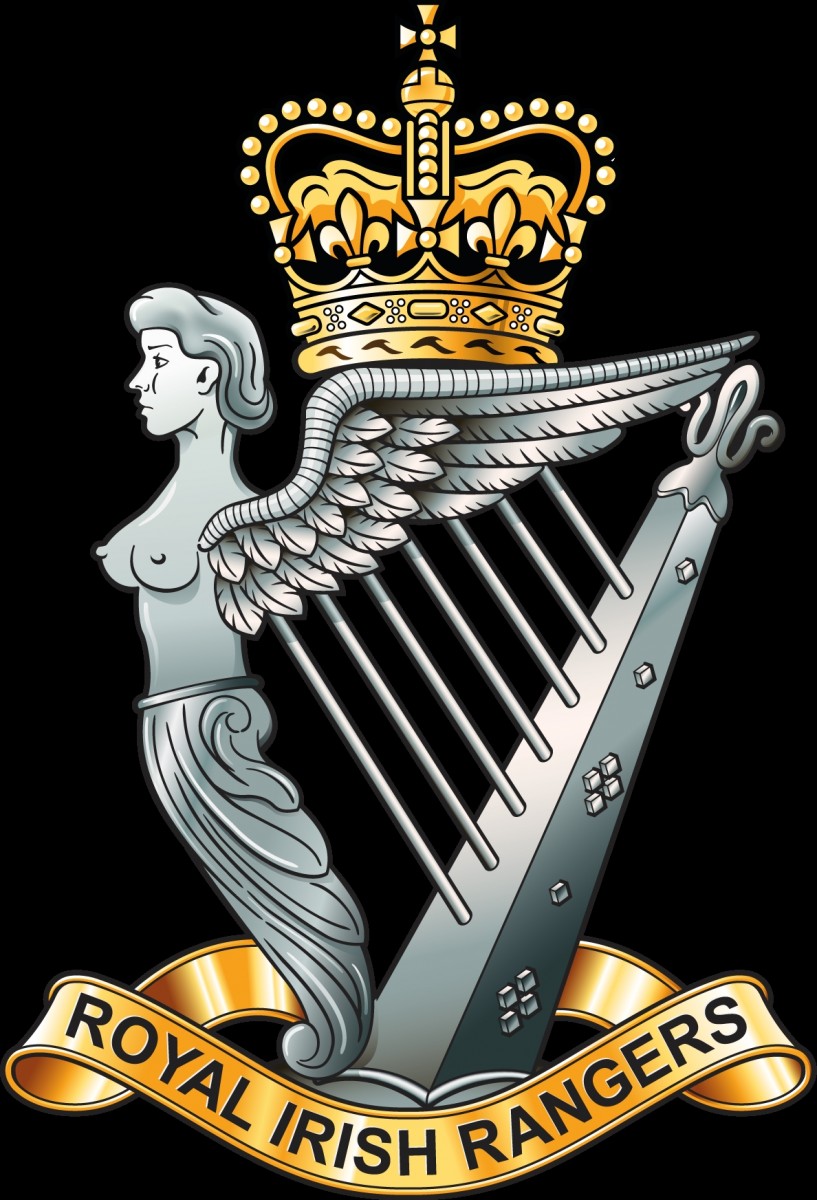
The Chief of the General Staff, General Sir John Chapple GCB CBE ADC Gen, had directed that amalgamating regiments could bestow on their Territorial Army battalions the distinction of carrying forward their former regiments' titles, customs and traditions. The 4th (Volunteer) Battalion The Royal Irish Rangers (The North Irish Militia) was retitled 4th Battalion The Royal Irish Rangers (Volunteers). The abbreviated title changed from 4(V) R IRISH to 4 RANGERS. However, 4 RANGERS continued to wear the distinctive North Irish Militia capbadge.