


Explore Listing
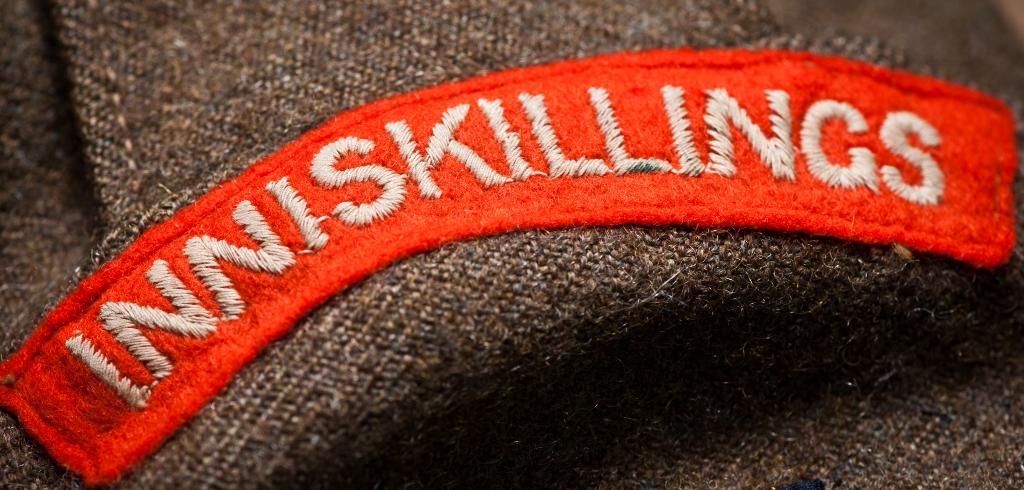
On 6 October 1943, the 6th Battalion The Royal Inniskilling Fusiliers with the 1st Battalion The Royal Irish Fusiliers (Faughs) on their right, moved out of Termoli, Italy, and assaulted the 16 Panzer Division defences to the north of the town. The battle was won in six hours. The Inniskillings had light casualties, one being the Commanding Officer while moving forward on a recce. The Germans lost heavily both in men and equipment. Major Proctor RUR, commanding A Company 1st Faughs, was awarded an MC for his actons on that day.
In Italy on 29 November 1943, the 6th Battalion The Royal Inniskilling Fusiliers attacked the fortified hill known as Licolle, seizing it after a ferocious battle that went on for much of the day.
During the battle, the 1st Battalion The Royal Irish Fusiliers, while waiting to be called forward from the bridgehead, suffered many casualties from enemy shelling.
The 38 (Irish) Brigade's infantry casualties that day were 28 killed, 55 wounded and 3 missing.
The 38 (Irish) Brigade attack, northwards from the bridgehead over the River Rapido, continued.
 When 38 (Irish) Brigade had finished its battles in the area of Lake Trasimene towards the end of June and early July, it was withdrawn to the 78th Division rest area between Rome and Tivoli. Soon afterwards it moved to Egypt for two months.
The 7th and 8th Battalion The Royal Irish Fusiliers were part of 49 Brigade, 16th (Irish) Division and received orders around 1 February 1916 to set off for France. The Brigade arrived in Le Havre in mid-February. The slow move forward to the front was by train and marching until arriving in early April in the front line at Hulluch to the north-east of Loos.
The first three weeks were spent learning lessons in how to avoid unnecessary risk and accepting the unavoidable as German snipers and rifle-grenades picked off a few men each day.
The 7th and 10th Battalion The Ulster defence Regiment amalgamated to form the 7th/10th (City of Belfast) Battalion The Ulster Defence Regiment (7/10 UDR). The Battalion Headquarters was located in Belfast.
The 7/8th Battalion The Royal Irish Fusiliers was disbanded. Nine officers and 241 men were transferred to 1st Battalion, 11 officers and 220 men transferred to the 9th Battalion and the remaining four officers and 130 men were posted to other Irish regiments.
Often used as an image to illustrate accounts of the 1st (Airborne) Battalion The Royal Ulster Rifles, the image (right) is correctly attributed as 716 (Airborne) Light Composite Company (RASC) Company. The scene was captured by the photographer Sgt Christie of No 5 Army Film and Photo Section of the Army Film and Photographic Unit. The Imperial War Museum has amended its description to read:
 General Montgomery's Eighth Army was advancing along the Adriatic coast towards the Germans' Volturno Line. The lead infantry diviision on the coast was the 78th (Battleaxe) Division, commanded by Major-General Vyvyan Evelegh, and included 11 and 36 Brigade with 38 (Irish) Brigade located to the rear at Barletta.
All full-time and part-time companies of 7 R IRISH deployed on Exercise IRISH HARP to Stanford Training Area (STANTA). This is the first time in the Battalion's 29 year history that the full Battalion has been able to deploy on exercise together.